Stop babysitting your agents.
Stash is memory for your agents. Import your existing agent logs, and stop repeating yourself immediately.
$ stash plugin install
claude-code, cursor, codex, opencode

$ stash import ~/.claude/projects
✓ 412 sessions · 18.4M tokens

$ stash refine
✓ wrote 34 pages, 6 skills
Right now, you are the memory.
Agents do not learn from feedback, and they do not learn from the mistakes they made last week. So a person carries the context between runs. You repeat the same corrections, and you watch the agent to catch the same errors.
Import, refine, serve.
Import your existing logs
Stash reads the sessions already on disk from Claude Code, Cursor, Codex, and OpenCode. New sessions stream in through one plugin.
$ stash import ~/.claude/projects
412 sessions · 18.4M tokens
capture is on for new runs
Refine them using sleep-time compute
Work that repeats becomes a skill: a folder with a SKILL.md that an agent installs and loads on the next run. The rest becomes a wiki of pages that your team and your agents both read.
Serve as a virtual file system or MCP
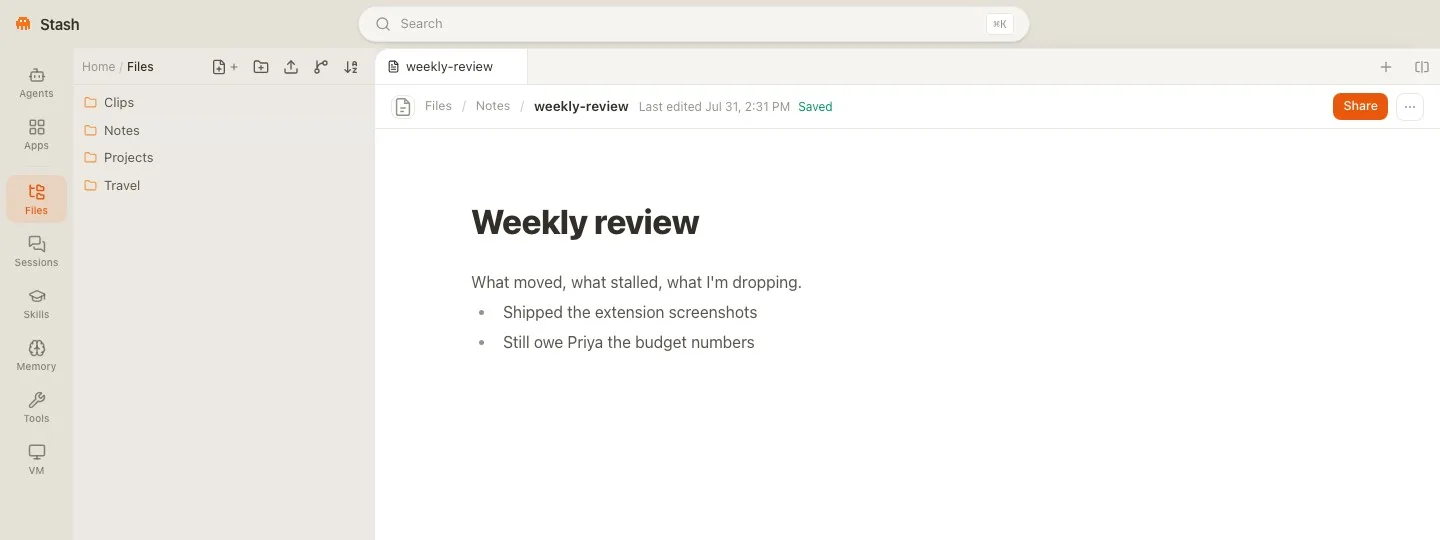
Your Stash mounts over MCP and the CLI. Agents run ls, find, and rg against it. There is no new API.
› stash vfs "rg 'rate-limit' /"
8 hits · files/gateway-limits.md
        · sessions/sam:tue-14:22
One memory, shared by the whole team.
An agent session is not private work. When one engineer's agent works something out, every other agent and every teammate should be able to read it on the next run.
Everyone reads the same context
A skill written from one person's session loads for the whole team. Nobody has to be told it exists.
Humans and agents edit the same files
Pages are Markdown, HTML, CSV, and PDF. A teammate corrects a page, and the agent reads the correction on its next run.
Send a session as a link
Share one session or a whole folder. The person who opens it sees the transcript and the files that came out of it.
Publish what is worth publishing
Make a skill public and it gets a URL. Another team installs it with one command.
Your data, and the intelligence built from it.
A memory layer accumulates value with every run. That value should accumulate inside something you own, not inside a vendor you rent.
- 01
Open source
MIT licensed. Read the code, fork it, and run the same thing we run.
- 02
Self-hostable, or managed
Run the whole stack inside your own network, on your own Postgres. Or use our managed cloud and skip the operations work.
- 03
Plain files, no lock-in
Pages, tables, and skills are ordinary files in formats you already use. You can take them with you.
- 04
Bring your own agents
Claude Code, Codex, Cursor, OpenCode, Openclaw, and Hermes write into the same Stash. You are not tied to one harness or one model.
Memory is not just a retrieval problem.
Vector search and knowledge graphs return things that look like the question. They do not decide what is still true, what applies here, or what to leave out. We treat recall as reasoning, and that is where our benchmark results come from.
Blast radius
The correct slice of history changes with the time, the project, and the person who asks.
Stability
New information must not remove what is still correct, and quality must not fall as the store grows.
Native primitives
Models are post-trained on bash and markdown. We serve memory through those, not a special API.
State of the art
We have achieved SOTA results on LongMemEval and LoCoMo.