Stash: State of the Art on the BEAM 10M Benchmark
By Coleman DuPlessie and Priyadarshan Narayanasamy ·
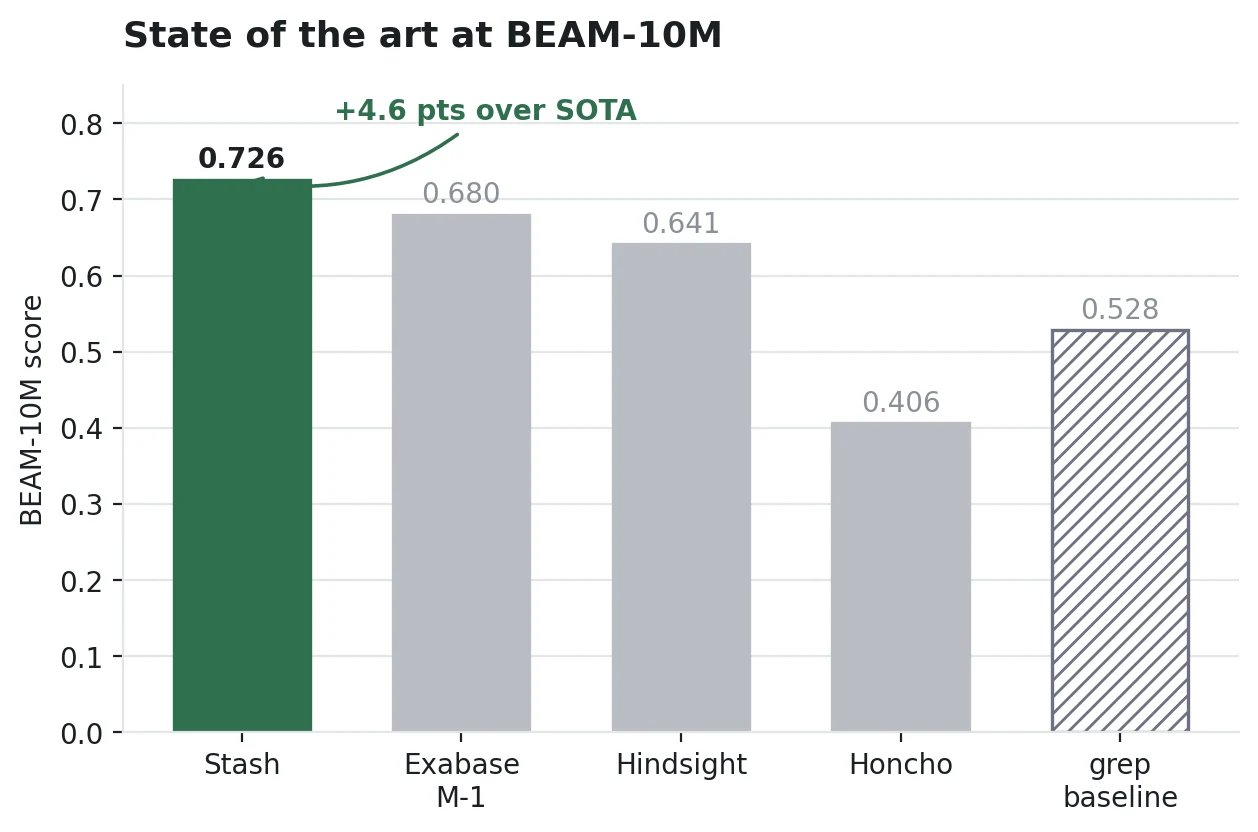
Figure 1 — Stash sets state of the art at BEAM-10M, the largest scale the benchmark evaluates. Stash 0.7256, Exabase M-1 0.680, Hindsight 0.641, Honcho 0.406, grep baseline 0.528.
Introduction
How do we make agents handle corpora effectively once they exceed their context window?
Historically (in ~2023!), the solution to this is known as RAG (Retrieval-Augmented Generation), which uses vector search to inject semantically relevant information into the context window at inference time. Since then, the space of techniques has expanded to include knowledge graphs, leveraging databases, and building LLM wikis. The emerging consensus as of this writing is to use a series of markdown files stored in a virtual file system that an agent can grep over. While this is highly effective for smaller corpus sizes, it scales extremely poorly in both accuracy and token spend, and can be prone to confabulation and catastrophic forgetting. This is because, when given only a filesystem, agents have great difficulty proving that some semantic element is not present within that filesystem. This is very relevant to both benchmarks and real-world use, as there are many situations where we may have one transcript with an outdated answer to a question, which has then been superseded by a newer transcript with fresh changes. When armed with nothing more than a filesystem, a model cannot be confident that it has the most up-to-date, accurate version of any piece of information unless it reads a lot of transcripts and documents that are ultimately irrelevant.
For example, let’s assume a corpus contains user growth figures from last week and a revised figure based on a new methodology. Under existing retrieval-based memory approaches, the agent can’t tell which figures are up-to-date without reading the surrounding context of each. It also can’t tell whether an even newer version exists somewhere its queries didn’t find. At 100K tokens this might be reasonable, since an agent can traverse the entire corpus easily. At 10M and above, issues like this lead to confidently wrong answers. Moreover, memory is as much about forgetting as it is about remembering. No matter how good retrieval is, adding more and more information to the corpus will deteriorate its performance because the difficulty of a retrieval problem scales with its corpus size.
We designed Stash to solve these problems. Stash organizes all of your data, from important files and internal documents to agent trajectories, into a virtual filesystem agents can easily search over. It then automatically reads from that filesystem to create an internal wiki for your organization or project. These two insights are important: agents are post-trained extensively on navigating file systems, which is why our memory system is file-system-shaped. We create and curate a wiki in order to allow models to access the important parts of your organization’s history and knowledge base without having to read or grep through millions of tokens of transcripts every session.
The core insight behind Stash, which puts it above alternative memory models like simple agentic search or knowledge graphs, is that we can use LLMs to usefully turn a user’s corpus of many disparate transcripts into specific, concrete insights that can be delivered cheaply and compactly to your agents. They can then be cheaply updated on-demand in a lazy fashion as we add new information into the system. Every retrieval operation also becomes an update operation where we decide whether to update the existing insights to prevent information from becoming stale. By paying a small upfront cost, in the form of model calls that constantly and proactively integrate new transcripts into your Stash’s knowledge base, we are able to attain consistently state-of-the-art performance on benchmarks while dramatically reducing answer time and scaling better with number-of-tokens than normal dreaming/sleep-time systems.
How we think about benchmarks
The previous generation of memory benchmarks, like LongMemEval-S, LoCoMo, and others, contain corpuses of data that are easily able to fit inside modern LLMs’ context windows of ~1M tokens. This makes them very useful for testing models’ recall within their context windows, but ultimately means that they are wildly unrepresentative of real-world memory tasks on the scale of projects or organizations. Since these datasets can fit into a single context window, they tend to be saturated when memory systems test on them: all systems score within a couple percentage points of the theoretical maximum. Benchmarks like LongMemEval-S are therefore not useful as measures of a memory system’s capability because they are not able to distinguish between different systems. Instead, they are often measuring benchmaxxing (e.g. prompt optimization, model choice, etc.) with some companies reporting scores greater than the theoretical maximum.
The story of memory in real projects has, broadly, been a story of having more data than we know what to do with: individual agent transcripts can often contain more tokens than all the context associated with a LoCoMo question combined, and the ideal memory system will be able to retrieve data from arbitrarily large collections of input data. Thus, we believe that larger benchmarks like BEAM-10M, with corpus sizes of over 10M, are better suited to testing modern memory systems. Note that we had a new hire generate >10M tokens in his first week, so even 10M tokens fails to capture the true size of production systems. Moreover, these are largely still needle-in-the-haystack retrieval benchmarks which fail to capture the full requirements for a good memory system, but they are a good necessary step on the path to true agentic memory. In addition, we also value benchmarks that go beyond retrieval. The STALE benchmark tests a problem we internally label blast radius: information is bounded by time, scope, or priority. Stash nearly saturates STALE (see our post Why Memory Is Unsolved).
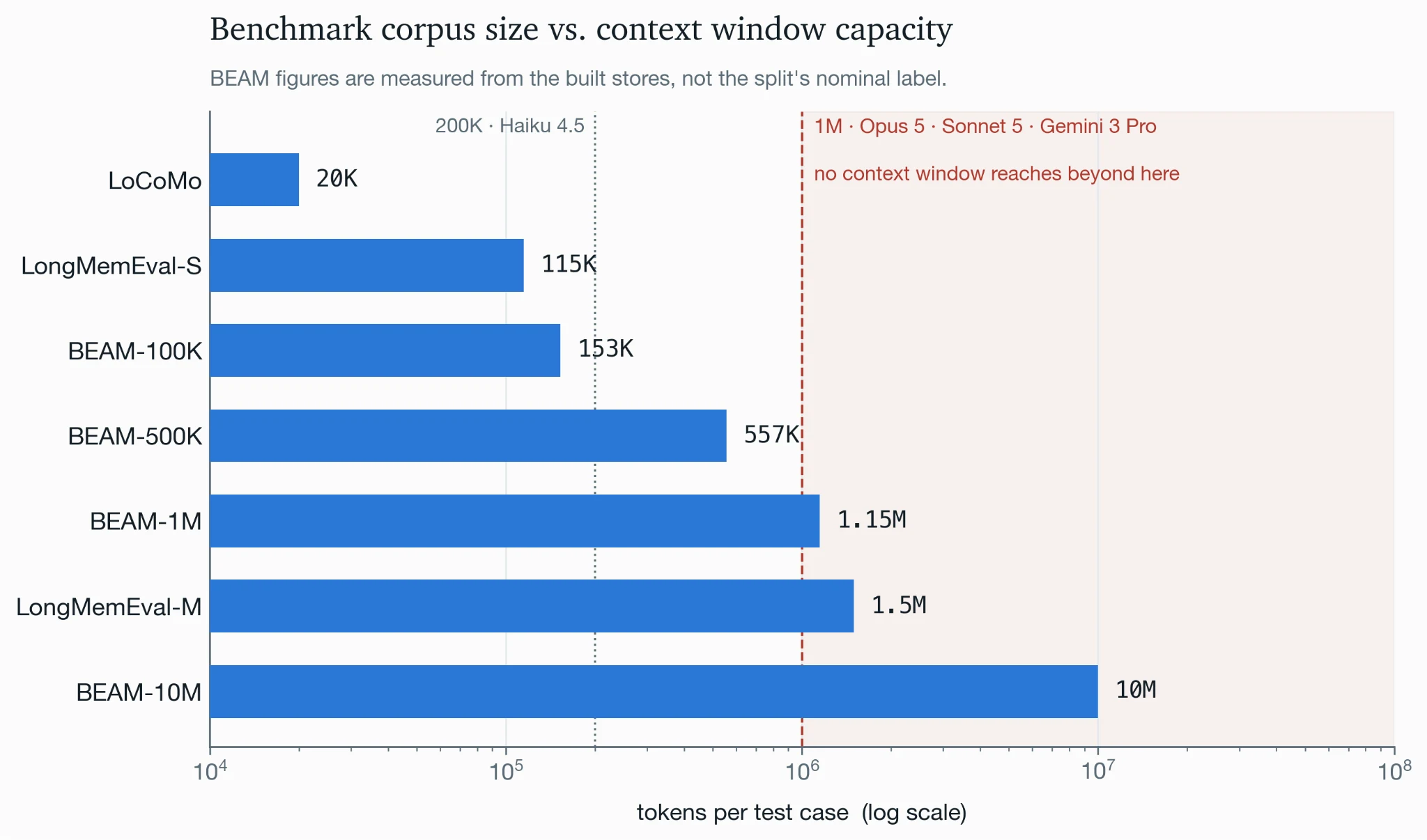
Figure 2 — LoCoMo and LongMemEval-S fit inside even the small context windows; BEAM does not.
Results
BEAM
BEAM is a benchmark that tests long-term memory in conversational agents at scales far too large to fit into any model’s context window. Each test case is a single simulated agent transcript of 100K to 10M tokens, spanning hundreds of simulated days in which facts are stated, revised, and contradicted. Scoring is nugget-based: reference answers are decomposed into atomic criteria and an LLM judge scores each at 0, 0.5, or 1.
| Split | Stash | Exabase M-1 | Hindsight | Honcho | grep baseline |
|---|---|---|---|---|---|
| 100K | 0.8008 | 0.769 | 0.734 | 0.630 | 0.720 |
| 500K | 0.7656 | — | — | — | — |
| 1M | 0.7692 | 0.750 | 0.739 | 0.631 | 0.657 |
| 10M | 0.7256 | 0.680 | 0.641 | 0.406 | 0.528 |
Stash leads at every scale, by +3.2 points at 100K, +1.9 at 1M, and +4.6 at 10M. The margin is widest at the largest scale, which is the one that matters — 10M tokens is roughly a week of daily agent conversations, or a company’s entire internal documentation corpus.
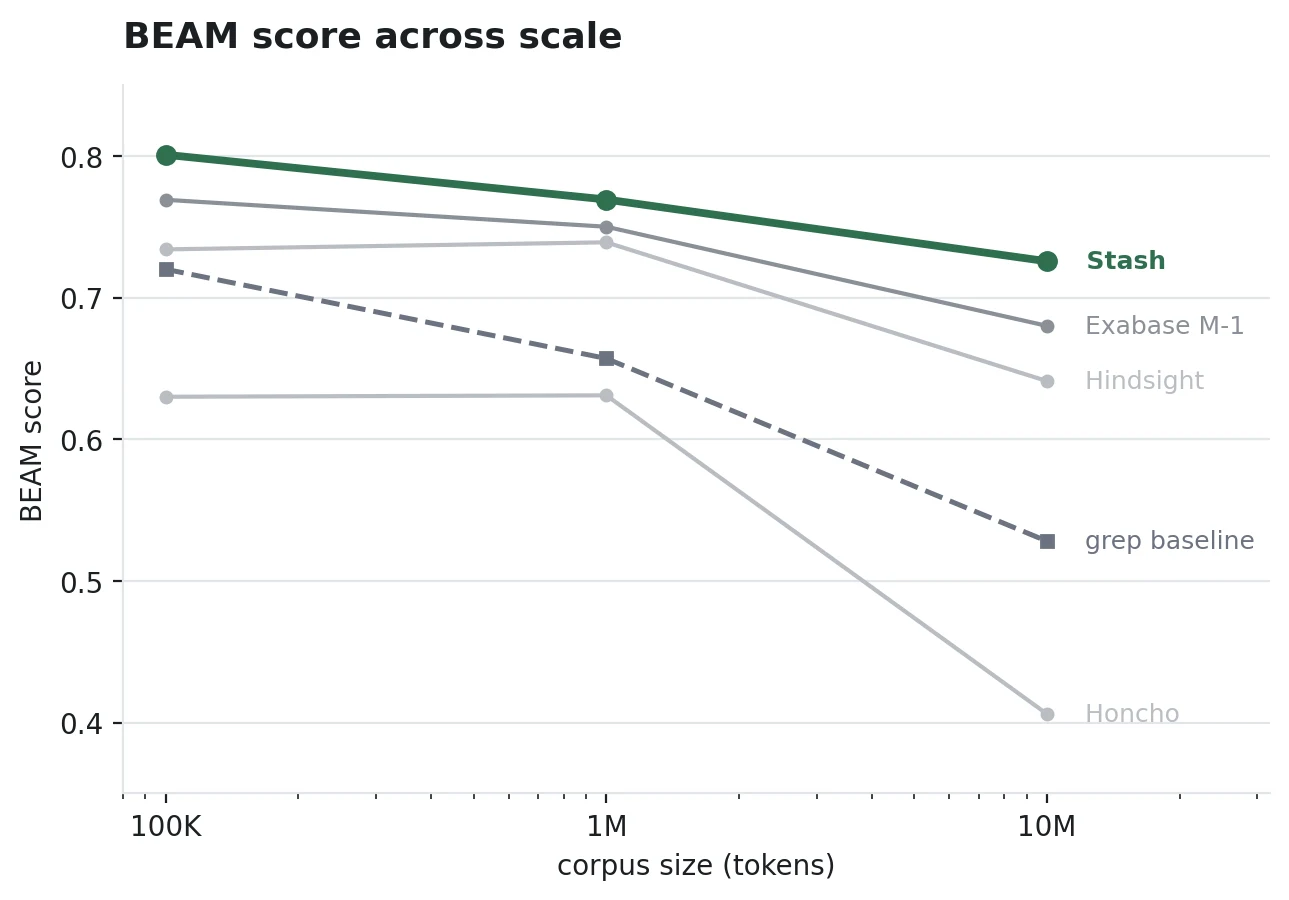
Figure 3 — Stash leads at every scale, and the grep baseline drops sharply as the corpus grows.
| Split | Stash | grep | Abs gain | % gain |
|---|---|---|---|---|
| 100K | 0.8008 | 0.720 | +0.081 | +11.2% |
| 1M | 0.7692 | 0.657 | +0.112 | +17.1% |
| 10M | 0.7256 | 0.528 | +0.198 | +37.4% |
The advantage more than triples from 100K to 10M. Almost all of that comes from the baseline collapsing rather than from Stash improving: grep gives up 19.2 points across the range, Stash gives up 7.5. Curation is a fixed overhead paid against a corpus that keeps growing, so the bigger the corpus, the better that trade looks.
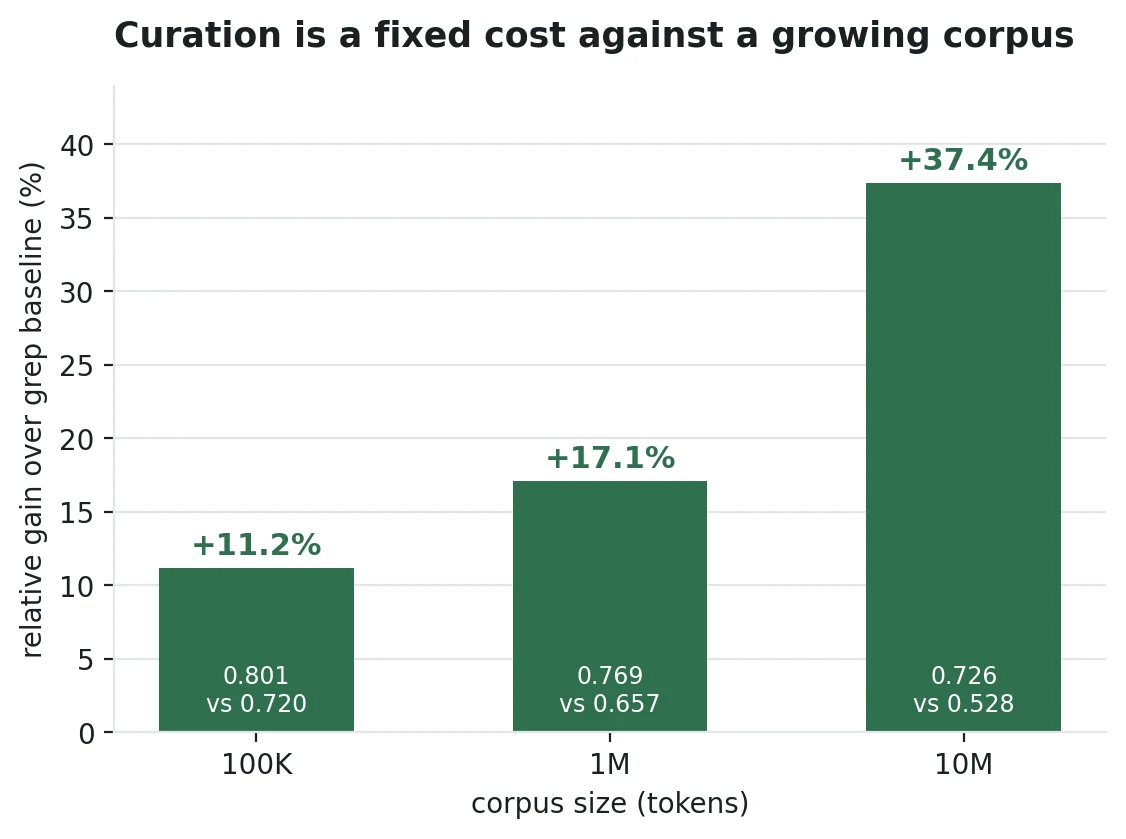
Figure 4 — The advantage over a grep baseline more than triples from 100K to 10M.
Token use and cost
Curation costs roughly $0.18 per million tokens of corpus, and that figure holds across a 13x range in corpus size: $0.57 at 100K, $3.57 at 500K, $7.29 at 1M, which works out to $0.185, $0.183, and $0.181 per million respectively. The write path therefore scales linearly in the size of what it ingests, with no compounding cost as stores grow.
All-in cost, covering curation, answering, and judging:
| Split | Curation | Answering | Judging (eval only) | Total |
|---|---|---|---|---|
| 100K | $0.57 | $3.41 | $0.60 | $4.58 |
| 500K | $3.57 | $9.58 | $1.07 | $14.22 |
| 1M | $7.29 | $10.49 | $1.29 | $19.07 |
| 10M | $19.91 | $5.27 | $0.40 | $25.58 |
There are two ways to look at cost here, and they point in opposite directions. The first is cost per million tokens of corpus, which drops about 6x from 100K to 10M. That looks great, but it’s mostly a side effect of how BEAM is built: every conversation gets 20 questions, however long it is. A bigger conversation means the same number of questions spread over more tokens, so cost per token falls almost automatically. We don’t think that number tells you much about Stash.
The more useful number is cost per question, which rises from about a cent at 100K to about 13 cents at 10M. It does rise, but much more slowly than the data does. From 100K to 1M, each conversation gets about 7.5 times bigger, while cost per question only goes up about 2.4 times.
The reason is that the agent doesn’t need to read much more as the corpus grows. Going from the 500K split to the 1M split, each conversation roughly doubles in size. The context the agent pulls in to answer a question only grows 18% (from about 27,500 tokens to 32,600), and the cost of answering goes up just 9%. Across the full range, conversations grow about 70 times from 100K to 10M, while retrieved context only grows about 3 times, from 18,500 tokens to 57,000.
The part that does grow with the corpus is curation, the work Stash does once when data comes in. Think of it as an upfront cost. For each conversation, curation costs about as much as answering 7.5 questions at 500K, or 14 at 1M. After that it never has to be paid again, however many questions follow. With BEAM’s 20 questions per conversation, curation still makes up 27% of the cost at 500K and 41% at 1M, and the more questions you ask, the smaller that share gets.
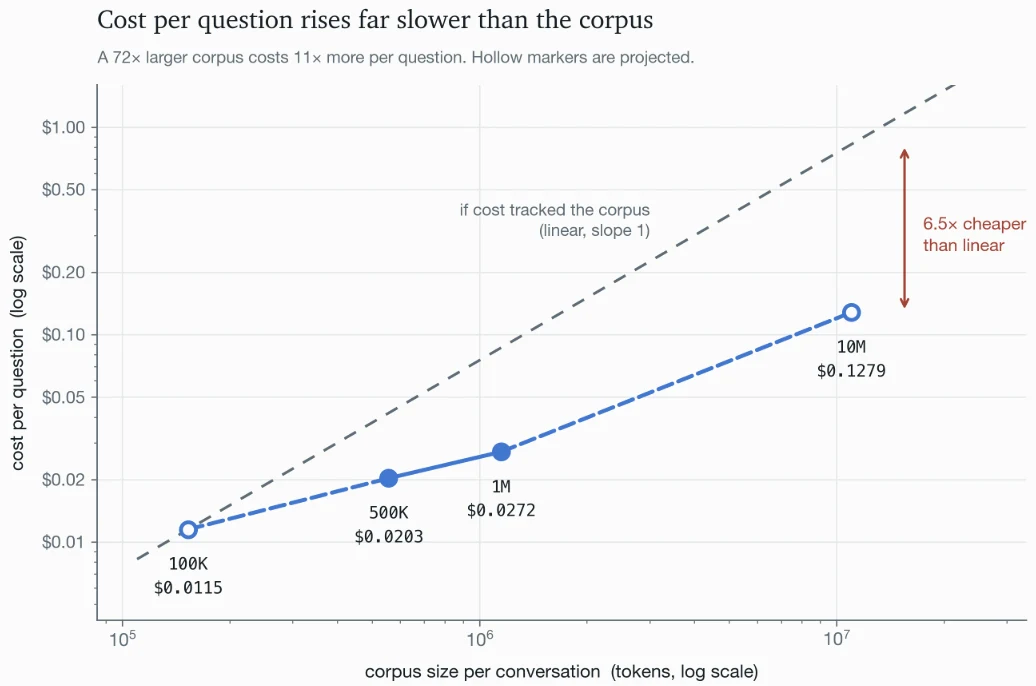
Figure 5 — Cost per question rises far slower than the corpus. Hollow markers are projected.
An additional question at this point: if the whole corpus fits in a context window, why not just put it there? On that view, Stash is only worth it once a project grows past a million tokens. Below that, you’d skip memory and let the model read everything.
Full context does work at that size, but it isn’t cheap. We took a 1.15M-token conversation from the 1M split and compared the cost of answering its 20 questions both ways:
| Approach | Per question | Per conversation |
|---|---|---|
| K3 full context | $3.45 | $68.93 |
| K3, 90% cache reuse | $0.50 | $9.99 |
| Stash + K3 | $0.075 | $1.50 |
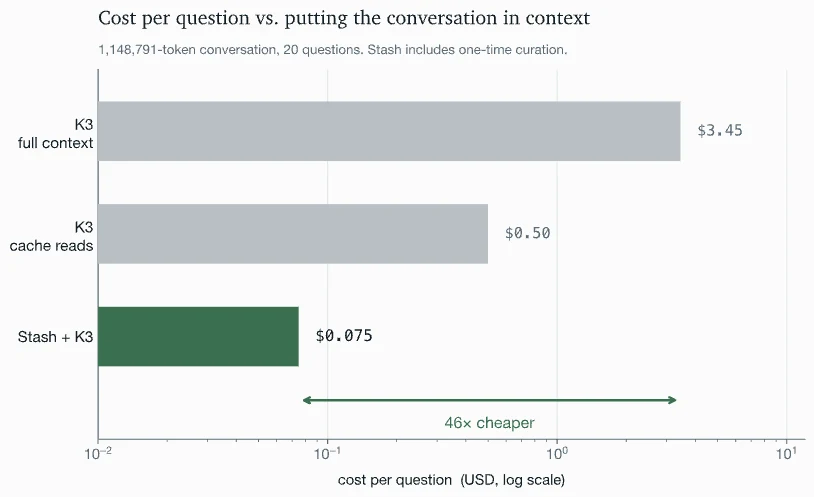
Figure 6 — Cost per question against putting the same conversation in context.
With full context, the model reads the entire conversation for every question, so you pay for all of it every time — about $3.45 a question, or $68.93 for all 20. Stash reads the conversation once, when it arrives. After that each question pulls in only the roughly 32,600 tokens it needs, so the same 20 questions cost $1.50 all in, curation included. That is 46 times cheaper. Caching narrows the gap, because the model doesn’t reprocess the whole prompt every time: with the prefix served from cache at a tenth the input price, the 20 questions come to $9.99. But that is close to a best case, and production rarely sees it. It assumes all 20 questions arrive in one burst inside the cache’s lifetime, but prompt caches expire in minutes while memory gets queried hours or months apart — so in real use most questions hit a cold cache and end up paying the full $3.45. Even on that generous assumption Stash is 6.7 times cheaper, and every cold cache just makes the advantage even bigger.
Methodology
Benchmark and scoring
We report all 35 conversations at 500K and 1M (700 questions per split), 20 conversations at 100K (400 questions), and 10 at 10M (200 questions) included in BEAM.
Scoring follows BEAM’s official nugget-judge protocol. Each reference answer is decomposed into atomic rubric nuggets, and the judge scores the response 0, 0.5, or 1 against each nugget using the benchmark’s own unified judge prompt; a question’s score is the mean over its nuggets. Event-ordering questions additionally receive the paper’s ordering metric — the response’s lines are aligned to the rubric events, then scored as normalized Kendall tau-b × F1, with that product taken as the question’s score.
Answering and curation
We curate and answer questions with Kimi K3 rather than a frontier model. To make sure that choice wasn’t costing us accuracy, we ran Sonnet 4.6 on the exact same stores and compared the two.
They came out about even. At 500K, K3 scored 0.7656 to Sonnet’s 0.7441 and did better on 20 of the 35 conversations. At 1M the scores were nearly identical, 0.7692 to 0.7661, with K3 ahead on 17 of 35. (Paired differences: +0.0217 at 500K, sd 0.068, t = 1.87; +0.0023 at 1M, t = 0.32.)
With only 35 conversations, neither gap is statistically significant, so we’re not claiming K3 is the better model. The takeaway is simpler: a model that costs way more to run gets you nothing measurable here.
Judge
All scores are produced by google/gemini-3-flash-preview. This follows Exabase’s published protocol, so that answering and judging traverse the same provider path and our results sit against theirs on comparable terms rather than being scored by a more or less lenient grader.
Conclusion
Stash achieves state-of-the-art performance on key memory benchmarks, with the greatest gains on the largest benchmarks that are closest to real-life use, such as BEAM-10M, where we improve on the state of the art by 4.6 points. Stash also nearly saturates the STALE benchmark. This shows that Stash’s internal agent wiki enables it to scale well to large projects with months of dense, changing history. Stash is able to turn those transcripts into consistent insights about a project’s state, enabling it to go beyond being a glorified context window extension, instead becoming a memory system that scales as your projects do.
Moving beyond the current state of the art, we’re excited to continue working on expanding Stash and making it more performant on the largest-context tasks, from large repos to whole companies.
Appendix: scores by ability
| Ability | 500K | 1M |
|---|---|---|
| preference_following | 0.951 | 0.885 |
| contradiction_resolution | 0.905 | 0.889 |
| information_extraction | 0.890 | 0.847 |
| knowledge_update | 0.868 | 0.804 |
| instruction_following | 0.848 | 0.879 |
| abstention | 0.736 | 0.821 |
| temporal_reasoning | 0.738 | 0.723 |
| summarization | 0.719 | 0.702 |
| multi_session_reasoning | 0.711 | 0.718 |
| event_ordering | 0.291 | 0.425 |
References
- Tavakoli et al. (2025). “Beyond a Million Tokens: Benchmarking and Enhancing Long-Term Memory in LLMs.” ICLR 2026.
- Wang et al. (2024). “LongMemEval: Benchmarking Long-Term Memory in AI Assistants.”
- Hsieh, C-P., et al. (2024). “RULER: What’s the Real Context Size of Your Long-Context Language Models?” COLM.
- Liu, N.F., et al. (2024). “Lost in the Middle: How Language Models Use Long Contexts.” TACL.
- Modarressi, A., et al. (2025). “NoLiMa: Long-Context Evaluation Beyond Literal Matching.” ICML.
- Hong, K., Troynikov, A., and Huber, J. (2025). “Context Rot: How Increasing Input Tokens Impacts LLM Performance.” Chroma.