Containerizing memory: the real barrier to continual learning and enterprise AI adoption
By Sam Liu ·
Originally published on X.
London. The year is 1500. Your mission, should you choose to accept it, is to abandon your life in the present to live as King or Queen. All that glory, wealth, and power. And yet you likely said no. This is a testament to the extraordinary difference in quality of life and material wealth between a commoner today and a king of yesteryear. There is no shortage of proposed catalysts. The steam engine. The scientific method. Plumbing. Controversially, capitalism.
I submit another one for your consideration.
Not just the shipping container, but the idea of consistency it represents. Before, cargo moved as a chaos of barrels, crates, and sacks. Each a different size and shape. Each hand-loaded by armies of dockworkers. Each port of call a week of wrestling the ship’s hold into order. It was slow, expensive, and ripe for breakage or theft. After, the world’s freight collapsed into an interchangeable steel box of agreed-upon dimensions: liftable by any crane, stackable on any ship, latchable to any truck. Shipping costs fell so low that they effectively stopped mattering.
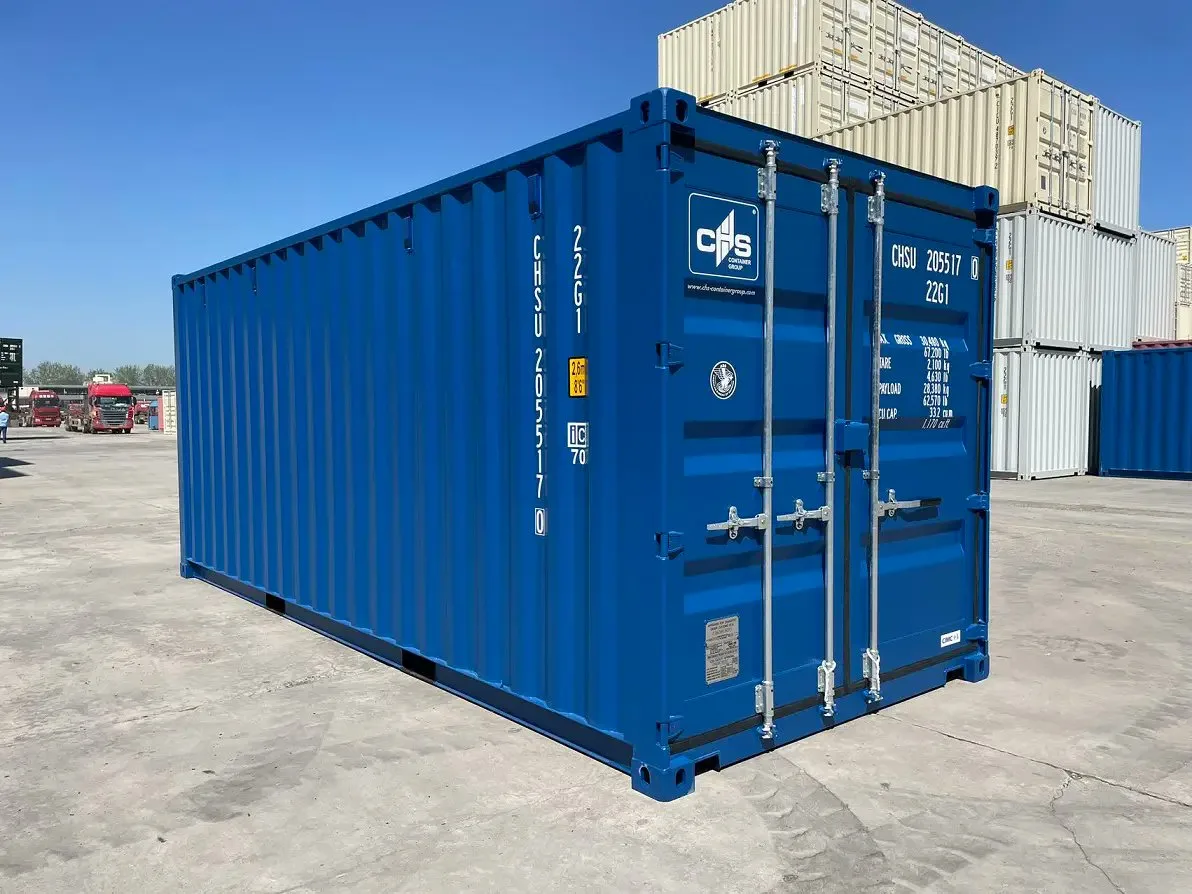
One agreed-upon steel box. Liftable by any crane, stackable on any ship, latchable to any truck.
And so it goes with the entire story of the industrial revolution and beyond. Flat planes and lathes gave us precision manufacturing, making the steam engine viable. Standardized screws made mass assembly of anything from furniture to firearms possible. In later years, ISO standards in everything from the dimensions of a credit card to the format of a date became the hidden foundation modern society is built on. The descendants of those precision flat planes make it possible to manufacture transistors so small that more than ten thousand fit across a human hair.
The very aspects of modern society we often blame for stripping us of our humanity — the monotonous job on the assembly line, the identical product stamped out a million times, the cookie-cutter big box store — are also the very things that created our comfort today.
Why consistency is so important
The underlying reason consistency is so powerful is that it produces reliable and predictable outputs, which can then be safely built on top of. You cannot construct a building on a foundation that is constantly changing shape. Stacking complexity is only possible when the layer beneath is stable enough to be ignored. Standardization means you only have to focus on the specific problem you are solving, because you trust that the other problems are handled. Ironically, standardizing a process creates more freedom by enabling greater possibilities. Every complex system in the world, from financial markets to supply chains to the internet, is a stack of things that coordinated to be predictable enough that the next layer up could stop worrying. Without it we would be stuck with only what one person can solve alone, instead of having an entire civilization’s efforts compound.
There is an additional benefit: scalability. For manufacturing and shipping, standardization enabled huge economies of scale through rapid assembly lines and massive container ships. Standardization is how you get more output for less input, because fewer decisions have to be made. You decide once and it scales across everything. Otherwise decisions constantly have to be remade, with inconsistencies causing cascading changes.

Standardization is how you get more output for less input. You decide once, and it scales across everything.
There is a crucial caveat: pure consistency is not the whole answer. Computers are the clear example. Code is perfectly consistent — it executes exactly as written, every single time. But not until LLMs and agents did we seriously believe computers could automate most office work. The answer to this tension can be found in hammer swings. In the 1920s Nikolai Bernstein studied expert blacksmiths and found that they are less consistent in their swings than mediocre blacksmiths.

Bernstein’s motion study. The expert’s swings vary; the blades do not.
The magic isn’t consistency alone. It also involves feedback loops. This is one of the other pillars behind the remarkable precision of modern manufacturing: control systems that self-correct on target. This works for thermostats, for transistor manufacturing, and increasingly for reasoning tasks too. That tacit, correcting intelligence is exactly what a modern AI model does. Where normal code is rigid and unflinching, agents can adapt and self-heal when something goes wrong — which is likely why we see reliability increase with intelligence. They are better at getting back on track. This verification and self-correction loop is the core technique behind state-of-the-art methods on benchmarks like ARC-AGI. Note, though, that the outputs are still consistent. The expert blacksmith produces better blades because the blades themselves are more consistent, even if the swings are not.
How this applies to AI
In the age of agents, the input we spend is tokens, which are proxies for the scarce resources of capital, time, and energy. When an agent can call a well-defined API to access data, that is enormously cheaper than having it reason its way through a workaround each time. This hints at a core principle for working with agents: speak in their native language. Labs have spent hundreds of millions training agents to be good at manipulating a specific set of formats — HTML, markdown, JSON. Using anything else is an uphill battle, forcing the agent to use its improvisation skills rather than its memorization.
Think of the agent as a 4x4 off-roader that can grind across snow, marshes, and rocks. Although it can go anywhere, it is still faster on a highway than in the mud. The intelligence of the model is the off-road capability. More of it means it can go further off the beaten path — but you still want to build the road.
The failure mode is that we have been relying on the feedback cycle, the agent’s intelligence, for far too long. As long as models kept improving, we felt we were headed in the right direction. But the rapid pace of model improvement hid the shaky foundation. This is the core reason agent adoption in enterprises has been mixed. For a small team, occasional downtime and instability is fine. For a large organization with millions of customers, it is unacceptable. Consistency and feedback have to work in tandem; one cannot live at the expense of the other. Without consistency there is no reliability, and without reliability there is nothing solid for the next layer to stand on. We are then all craftsmen making singular objects rather than building industrial-scale systems.
There are early attempts to industrialize this. On the weight-space side, LoRA gave us small, snap-on modules to fine-tune models, remarkably sample- and cost-efficient for how much they improve performance on specific problems. But each adapter is welded to one base model, so every time a smarter model ships you relearn the adaptation from scratch. Ramp Labs’ PorTAL is an early attempt at solving this, porting a LoRA module onto an entirely new model by refitting only a thin per-base converter on a handful of examples. On the orchestration side, managed agents and hosted MCP servers are trying to turn the disposable, break-prone session into something durable and shared.
A vision for the future
We believe the future takes these lessons from the industrial revolution by focusing on modularity, made possible by consistent interfaces and feedback loops. Three pictures of what that could look like:
The Matrix: portable memory
“I know kung fu.” Memory will be modular, independent cartridges that can be loaded into an agent at will. When loaded, it gives the agent a set of memories representing capabilities — a specific writing style, company SOPs — or information, such as regulations on the maintenance of aircraft parts. This modularity also solves the data isolation and security problem agents face when deploying across orgs: we can selectively choose what information an agent has access to and remembers. Skills are an early example, but suffer from context pollution and token space limits. The Cartridges paper and PorTAL are steps in the right direction.
The docking port: self-healing connections
PorTAL has a second property that matters just as much as portability: the adapter’s link to a new model is self-building. Today, agents’ connections to tools and data constantly break. Think about how spacecraft dock. A small probe makes contact first, establishing a fragile, low-throughput connection. Only once that holds does the mechanism latch and draw the two craft into a rigid, high-bandwidth seal that astronauts can pass through. Agents are built for exactly this manoeuvre. The probe is the model reading the docs and fumbling through a first API call. Over time the agent hardens that path by writing dedicated code highways to replace the improvised per-call reasoning, and repairs the pathway on its own when a schema drifts or an endpoint changes.
Build-A-Bear: modular agents
Take Anthropic’s principle of separating the brain from the hands to its logical conclusion. Have universal interfaces between models, tools, execution environment, memory, and orchestration. Any agent could then be built through simple choices, the way you would at a Build-A-Bear workshop: select a brain, a heart, and a body.
If any of this resonates, Stash is working to make this vision a reality. See internal agents for the agents your team runs, external agents for the ones your customers use, or book a call.
References
- Ben Geist / Ramp Labs, “PorTAL: Portable Task Adapters for LLMs” — portable, base-agnostic task adapters
- Eyuboglu et al., “Cartridges: Lightweight and General-Purpose Long Context Representations via Self-Study” (HazyResearch) — arXiv:2506.06266
- Anthropic, Managed Agents — a step toward durable, modular runtimes
- Bernstein’s principle, repetition without repetition — the blacksmith’s non-identical strokes
- Marc Levinson, The Box — the shipping container as an engine of standardization